Navigating ambiguous futures
Who is supposed to have the answers? You, probably.
That is the expectation leaders carry. And you have more data than you could ever need, most of it a quick prompt away. So the answer should be in reach. Shouldn’t it?
The trouble is the problems have changed shape. They are too tangled, too fast, too knotted into everyone else’s problems to be solved by one person in one room. The work is no longer to arrive with the right solution. It is to take people with you. So why does it still feel as though you have to walk in carrying certainty?
Exploring the future asks for muscles most leaders have let go quiet. It asks you to sit in a room and not offer the answer. It asks you to build on someone else’s half-formed idea rather than defend your own. That is not what most careers reward. You rose by being right, by moving faster than the person beside you, by competing and winning. Now the work asks you to collaborate, to ask the better question rather than hold the better answer. Small wonder it feels unnatural.
There is a quieter confusion underneath this. You may say codesign but you mean consultation. You invite people to react to something already decided, then call it collaboration because collaboration sounds better. But consultation only asks what people think of your answer. Codesign asks what you might build together. One protects your plan and keeps the power where it was. The other risks changing both.
Which one are you actually doing?
Systems, not silos
To explore the future well, you have to think in systems rather than silos. A silo optimises its own corner and exports the mess somewhere else. A system sees the connections, the dependencies, the way a win here becomes a cost there.
So what holds it together? What is the common purpose underneath the org chart? Look hard enough and it is the customer. The person on the receiving end is the one thing every part of the organisation shares. They can unify what the structure divides.
What it costs to look away
The near term will stop you. There is always a fire. There is always this quarter. And the near term feels responsible, even virtuous, which is exactly what makes it so hard to step away from.
But the focus has a cost, and it arrives later. Starved of long-term thinking, strategy shrinks. It gets shorter, more tactical, more reactive, until it is barely strategy at all. You lurch from fix to fix and call it momentum. You follow the problems instead of getting ahead of them. The saving was never a saving.
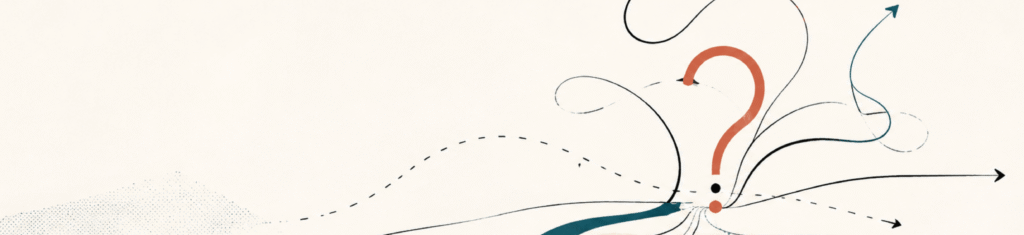
The way through is not to think harder on your own. It is to explore in the open, before the pressure to choose closes the options down. What would it take to hold a question open a little longer? And what value could it bring?
This is the work we do at brkrs. We help leaders hold a question open long enough to learn from it, turn half-formed ideas into tangible things you can test, and explore several futures before the pressure to choose closes them down. Not to hand you the answer, but to make the room a place where a better idea can emerge.