Most leaders are not short on data. They are short on contact with what it means.
Ask a leader about their customers and the numbers arrive without hesitation. Conversion rates. Acquisition costs. Satisfaction scores. Ask them what it feels like to be a customer on the receiving end of a service, or an employee caught between policy and doing right by a person, and the conversation gets quieter.
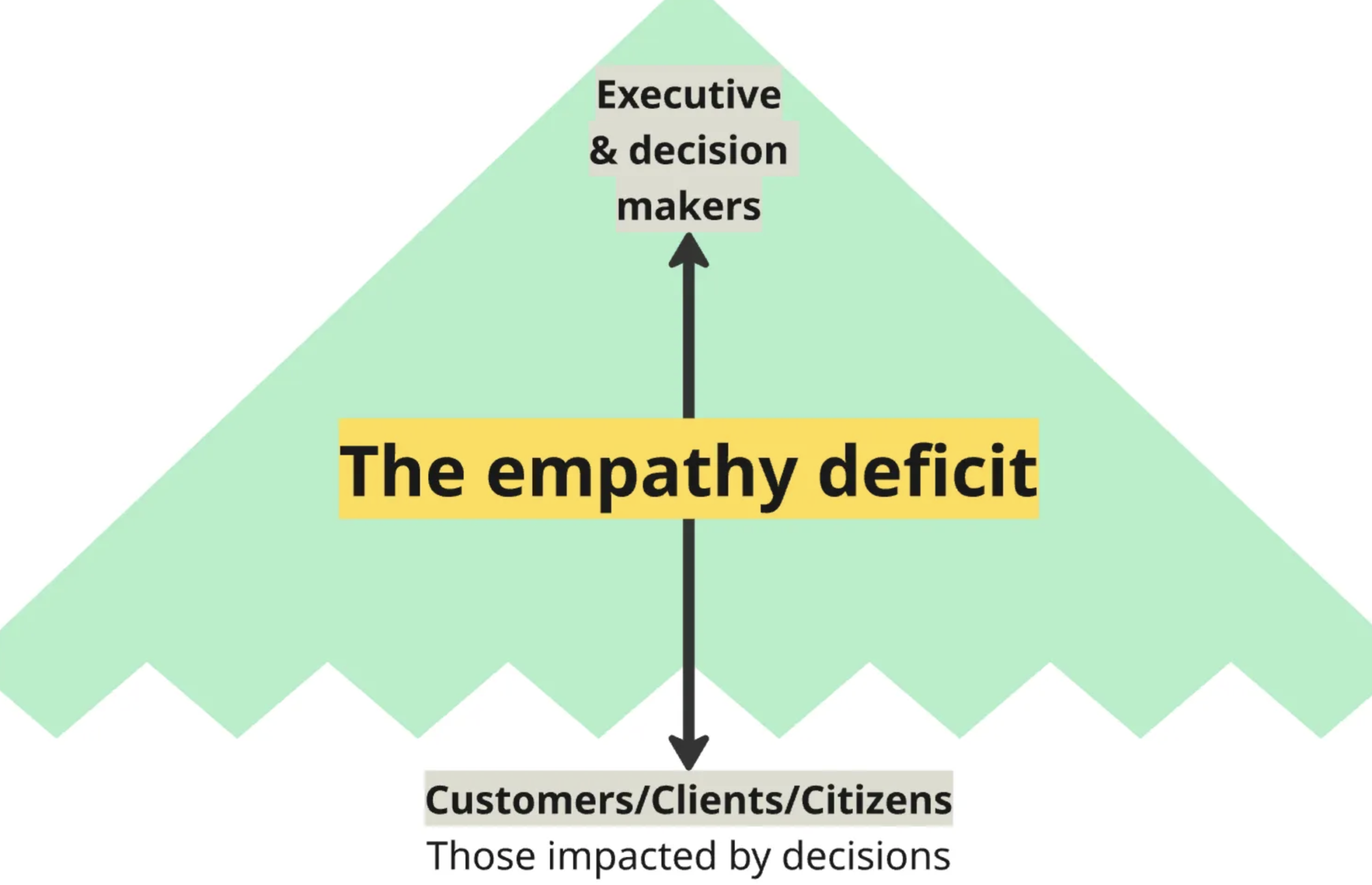
This is the empathy deficit. It is the growing distance between the people who make decisions and the people who live with them. It is rarely about character. Most leaders are well intentioned. The problem is structural. The systems that let an organisation work at scale are the same systems that cut its decision-makers off from the human reality of the work.
How leaders end up isolated
The gap widens as people rise. Physical distance grows. Days fill with other leaders who share the same view from the same height. Information passes through layer after layer of summary and softening before it lands. And few people want to carry bad news to the person who shapes their career.
The result is an echo chamber. Leaders hear sanitised versions of problems rather than raw accounts. They hear what worked elsewhere rather than why things are failing here. They hear metrics rather than consequences. The data is accurate and emotionally empty. A satisfaction score can tell a leader that something has slipped. It cannot tell them why. And a leader working from that thin a picture will often resolve it quickly and move on, confident in a reading that never touched the ground.
MIT senior lecturer Hal Gregersen describes this as the CEO bubble. Power and privilege insulate leaders from exactly the information that might challenge their assumptions and warn them of a looming threat or opportunity. In interviews with two hundred executives, he found almost none who did not recognise the problem in themselves. The success that carries someone to the top can quietly manufacture their blind spots.
What the gap costs
Disconnection has a price, and it is paid in the real world rather than the meeting room.
Automated systems that trap people in loops. Policies that fall hardest on the most vulnerable. Targets that set frontline staff against the customers they serve. None of these are the work of villains. They are reasonable-sounding choices made by people who have lost touch with what those choices feel like on the ground. A decision that looks clean from a distance can do quiet damage up close, and the distance is exactly what hides the damage from the person deciding.
The pattern shows up everywhere. In policies that make sense on paper and fail in practice. In investment that leaders believe will help and frontline teams find maddening. In change programs that ignore the emotional weight of carrying them out.
The measurement trap
Part of the problem is how we measure human experience. We reduce customers to a number and a decimal point. We track engagement through an annual survey. These instruments are useful for trends and useless for texture. They tell us what is happening and nothing about why. They treat qualitative insight as soft and quantitative data as truth.
The distance is measurable. Businessolver’s 2023 State of Workplace Empathy study recorded the widest divide it had ever seen between how HR professionals and leaders read each other. Ninety-two percent of leaders saw their HR people as empathetic. Only sixty-eight percent of HR people said the same of their leaders. Two groups in the same building, describing two different organisations.
What closing the distance takes
The good news is that none of this is inevitable. Some leaders stay connected despite every structural pressure pulling them away. They seek honest feedback from a wide range of people. They put themselves in situations where they are uncomfortable, occasionally wrong, and usefully quiet. They hold a question open long enough to learn something before they answer it.
Individual effort is not enough on its own. Organisations need to build empathy into how they work rather than hoping their leaders find it.
That means genuine time with customers and frontline staff, not the staged visit where everything smells of fresh paint. It can mean unfiltered channels that let raw information reach the top without being smoothed on the way. It can mean asking leaders to use their own products and move through their own processes as an ordinary person would. And it can mean synthesis that reveals patterns across every touchpoint rather than another isolated project or report that is too narrowly framed.
Structure matters more than sentiment here. Reward leaders for long-term human impact and behaviour follows. Build human consequence into significant decisions and it stops being optional. Make connection to lived experience a core expectation of leadership rather than a soft skill on the side.
Why this is where we work
Most human-centred work happens at the edges. The interface between a customer and an organisation. The service, the process, the policy as it plays out. That work matters, but it stops short of the room where the decision is actually made.
That room is where we work. We bring leaders back into contact with the human consequences of their choices, through the channels, the immersion and the synthesis that structural distance strips away. Not to move leaders onto the frontline, which is not their job, but to keep the frontline in view while they do theirs.
Every spreadsheet stands for real people. Every policy shapes real lives. Every decision travels well beyond the room it was made in. The empathy gap is real. It is not inevitable. The question is whether an organisation is designed to remember what it exists for, or left to let good people make harmful choices because they have lost sight of it.